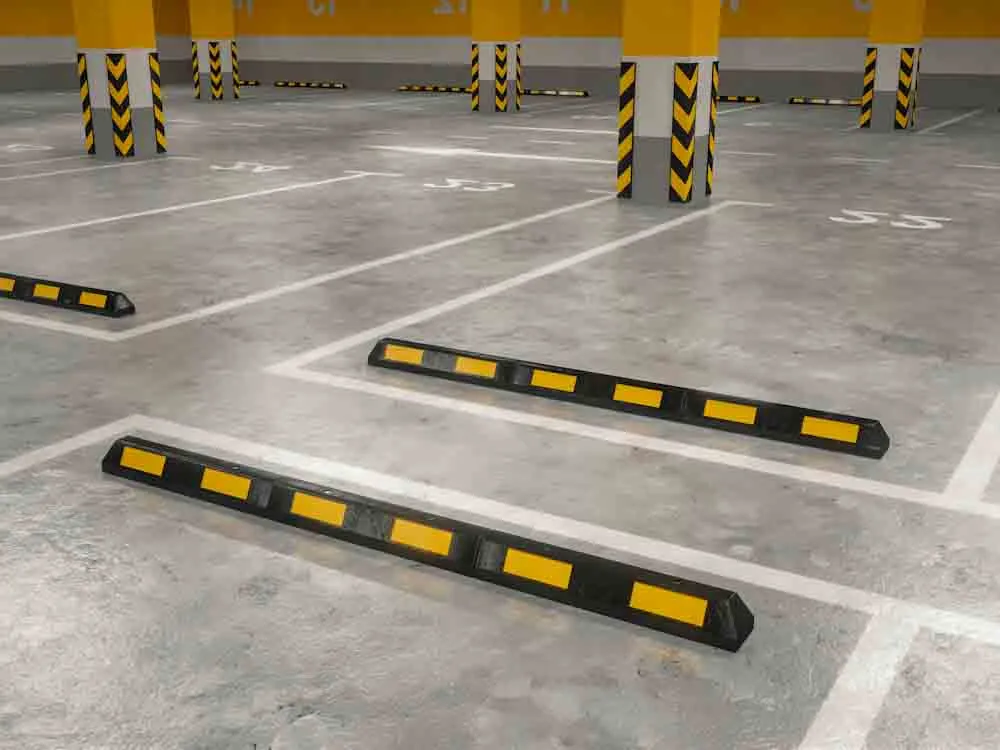
The question we hear most often is whether a lot "needs wheel stops in every row." The honest answer is usually no. Some Greensboro properties are safer with stops at the building face and nowhere else. Others need them along landscaped islands because cars keep climbing the curb. A few are better served by curbing, bollards, or a layout change than by another row of rubber or concrete.
This guide covers where stops actually help, when they create new problems, and why we prefer to install or replace them during a restripe instead of as a one-off afterthought.
Where wheel stops help most
Stops earn their keep near sidewalks, storefronts, landscaped islands, and building fronts — anywhere vehicle overhang can hit glass, pedestrians, or plantings. They also help keep angled rows honest so the first car in a line doesn't creep far enough to squeeze the walkway.
They are less useful in the middle of a wide field of stalls with no sidewalk behind them. In those rows, a stop is just something to trip over and something a snowplow or sweeper will eventually loosen.
Usually worth it
Think twice
ADA and pedestrian clearance
A wheel stop that sits in an access aisle or across the path from an accessible space to the door is a problem, even if the stall count looks right on paper. On Greensboro medical offices, churches, and retail centers — the lots where accessible spaces sit closest to the entrance — we check placement against the route, not just against the stall stripe.
If a person using a wheelchair, walker, or unloading a van would have to navigate around the stop, it doesn't belong there. We'll recommend a different stall, a different stop location, or no stop at all.
Signs it's time to replace what's already there
Anchors are loose or pulling out of the asphalt
A rocking stop is worse than no stop. It moves under a tire and becomes a trip hazard the next time someone walks the row at night.
The stop is cracked, broken, or sitting off-line
Concrete that has split and rubber that has torn no longer do the job. If the row was restriped and the stops weren't moved, they're often sitting in the wrong place relative to the new paint.
You can't see them after dark
Painted ends and reflective faces are part of the safety value. A faded gray stop disappears against asphalt at dusk.
The layout changed and the stops didn't
New ADA spaces, a reconfigured entrance, or added reserved stalls often leave old stops conflicting with the current plan.
Rubber or concrete?
Both work when they're installed on sound pavement and aligned to the stall. Rubber is easier to handle, less likely to shatter, and a better fit for lots that get occasional plow or sweeper traffic. Concrete is heavier and stays put on high-abuse rows, but a cracked unit needs replacing, not patching. We'll recommend based on how the lot is actually used — a furniture-warehouse dock apron is not the same job as a church lot in Summerfield.
Why we like to bundle this with striping
Replacement is most efficient when the lot is already closed for paint. We can verify spacing against the new layout, straighten rows that drifted over the years, and install signs and stops so they agree with each other. Doing stops months after a restripe usually means measuring twice against lines that have already started to wear, or worse, installing to the old geometry.
Many Greensboro owners pair this with parking lot signage, ADA updates, and sealcoating so the lot reopens as one finished surface instead of a sequence of half-done projects.
Are wheel stops required by code on every Greensboro lot?
No. Need depends on layout and site conditions. We install them where they prevent a real conflict — not as a default package on every stall.
Can you replace only the damaged ones?
Yes. We also check alignment so the replacements match the current striping, not the positions of the broken units they replace.
Do wheel stops need fresh paint?
Often yes. Visibility is part of the safety value, especially on busy retail and apartment lots after dusk.
Will installation close the whole lot?
Usually not. We can work a row or a section at a time. If we're already restriping or sealing, we plan the stops into that closure so you aren't shutting down twice.
Not sure your lot needs a full set of stops?
Send a few photos or ask for a walk-through. We'll mark where stops help, where they should come out, and what it costs to do the work with your next restripe.