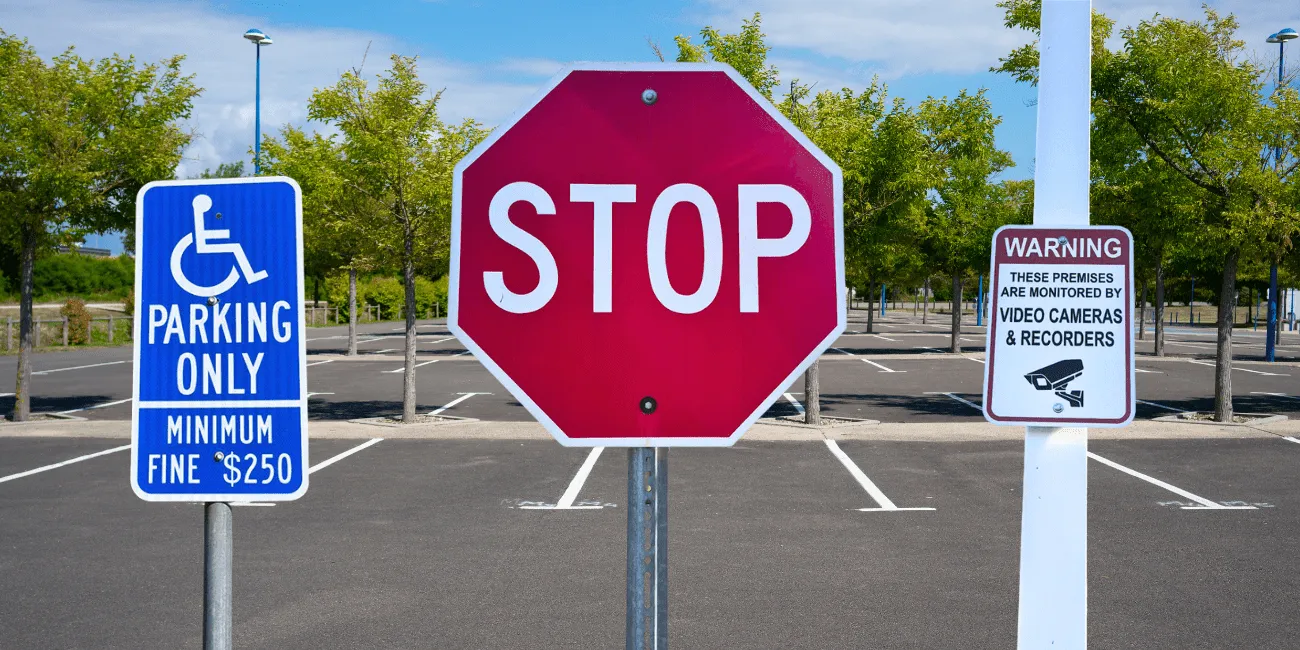
Signage is the part of a lot most owners notice only when something goes wrong: a reserved space that keeps getting taken, a fire lane that isn't obvious until someone parks in it, or an ADA stall whose sign disappeared after the last storm. On Greensboro retail, apartment, church, and office lots, we treat signs as part of the layout — installed when we restripe or reset wheel stops, not weeks later when the paint and the posts no longer agree.
This guide covers the signs that actually change how a lot behaves, what we check before we order posts, and why "just replace the faded one" is sometimes the wrong first step.
The signs Greensboro owners ask for most
Compliance
Operations
Property rules
Why signs have to match the striping
If the ground says one thing and the post says another, drivers hesitate. That hesitation shows up as crooked parking, reserved-space arguments, and fire-lane violations that look like defiance but are often just confusion. We install signs during restriping, ADA upgrades, or wheel stop work so height, placement, and the painted stall all belong to the same plan.
On busy Greensboro retail and multifamily properties, even a small, well-placed package — ADA, fire lane, and a few reserved or visitor signs — does more than a dozen leftover posts from previous tenants.
Too few signs create guesswork. Too many make the lot harder to read. We'd rather specify the eight signs your property actually needs than hang twenty "to be safe."
When a signage review is overdue
The lot was reconfigured and the signs weren't
A new entrance, added pickup zone, or restriped ADA row often leaves old posts pointing at stalls that no longer exist.
A tenant or use changed
Medical offices, churches, and shopping centers pick up visitor, reserved, and loading rules over time. The sign package has to catch up or those rules don't exist for drivers.
ADA corrections are already planned
Accessible spaces without the matching sign — or a sign left from a previous layout — are one of the fastest ways a "compliant" lot fails a review.
Posts are bent, faded, or blocked by landscaping
A sign you can't read from the drive aisle is decoration. Height, line of sight, and condition matter as much as the wording.
What we look at before we install
- Entry and exit patterns — so directional and stop signs sit where a driver actually makes the decision, not twenty feet past it.
- Fire lane visibility — curb paint and lettering plus a sign that still reads from a moving car.
- ADA sign placement — mounted so a parked vehicle can't hide it, and matched to the stall and access aisle on the ground.
- Tenant or resident rules — reserved, visitor, and permit language that people can enforce without a debate in the lot.
- Mounting and height — visible on approach, not buried in a hedge or set so low a van roof hides it.
- The rest of the layout — chances to combine signage with wheel stops or pavement markings instead of adding a post that fights them.
Partial replacement vs. a full package
We replace single damaged signs all the time. We also tell owners when a one-for-one swap will leave the lot looking patched — new reflective next to a ten-year-old faded panel, or a correct ADA sign next to a stall that no longer meets the aisle width. If the layout has drifted, a short review plus a small package is cheaper than swapping signs one complaint at a time.
Can you replace only a few damaged signs?
Yes. We handle single replacements and broader packages. If the rest of the set is badly faded, we'll say so before you order just one new panel.
Do signs need to match ADA layout changes?
Absolutely. Striping and signage should always agree — space type, van-accessible designation, and location relative to the accessible route.
Do you install directional and reserved parking signs too?
Yes. Compliance signs and operational signs are the same job: the right message, at the right height, where a driver can use it.
Should signage wait until after sealcoating or striping?
If those jobs are already scheduled, we plan signs with them. Posts can go in the same visit as striping or shortly after a seal coat has cured, so you're not closing the lot twice.
Need the signs to match the lot you have now?
We'll walk the property, list what to keep, replace, or remove, and quote a package that agrees with your striping — or install the two or three signs that are actually missing.