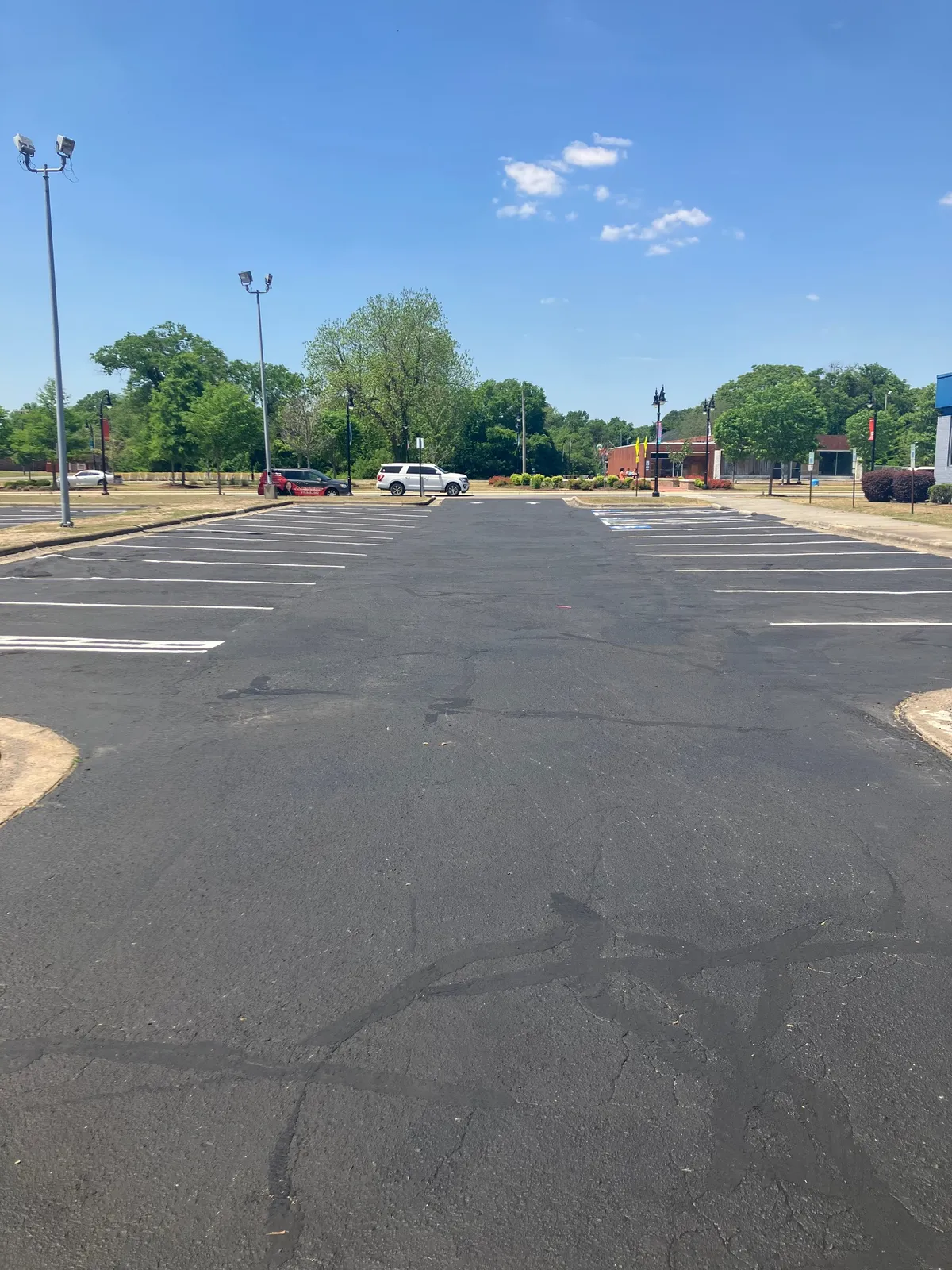
Most property owners don't notice their striping fading. It happens too slowly — a little duller every season until, one afternoon, a customer parks halfway into two spaces and you realize you can't actually blame them. The lines simply aren't there to guide them anymore.
Striping is the cheapest, fastest way to change how a parking lot behaves. It tells drivers where to go, where to stop, and where not to park, without a single conversation. When it fades, none of that guidance disappears from your responsibility — it just stops being visible. You still own the liability for the fire lane nobody can see; you just lose the paint that used to keep people out of it.
Below are the five signs we see most often on properties around Greensboro, High Point, and Winston-Salem, along with what's actually happening in each case and what we'd recommend if it were our lot.
Drivers are parking crooked, or straddling two spaces
This is usually the first sign anyone notices, and it's easy to blame on inconsiderate drivers. In reality, most people park inside the lines when the lines are visible. When stalls are hard to distinguish, especially at dusk or in rain, drivers default to guessing — and guessing produces exactly the crooked, space-wasting parking that frustrates everyone else. On a full lot, a handful of poorly parked cars can cost you several usable spaces during your busiest hours.
Accessible (ADA) spaces have faded to the point of being unclear
Accessible spaces rely on high-contrast blue-and-white paint and a clearly marked access aisle to function. Once that paint fades to gray, the space effectively stops being accessible even though it technically still exists on paper. This is the fastest way for a compliant lot to become a non-compliant one without anyone repaving or reconfiguring a single thing — the layout is fine, but the markings that make it usable are gone.
Fire lanes and no-parking zones have lost their contrast
Yellow curb paint and "NO PARKING — FIRE LANE" stencils are only useful if they're legible from a moving car. Once they fade, drivers park in them out of habit rather than defiance — they genuinely can't tell it's restricted. That creates two problems at once: an emergency access lane that isn't actually clear, and a property manager who now has to deal with towing and enforcement for something a fresh coat of paint would have prevented.
The lot looks older than the pavement actually is
We walk plenty of lots where the asphalt itself is in decent structural shape — no major cracking, no potholes — but the property still looks neglected because the paint has gone chalky and gray. Striping is one of the highest-visibility, lowest-cost updates you can make to a property's curb appeal. It's often the fastest way to make a perfectly sound lot look cared for again, without touching the pavement underneath.
You're already scheduling other lot work
If crack filling, sealcoating, wheel stop replacement, or signage updates are already on your list, that's usually the right moment to refresh the striping too. Paint has the best adhesion on a freshly cleaned or sealed surface, and combining the work means one mobilization instead of two. We see this most often with sealcoating: seal first, then stripe about a week or two later once the coating has cured.
Why worn striping is a bigger deal than it looks
It's easy to file restriping under "cosmetic," but the practical effects reach further than appearance. Confused traffic flow increases the odds of fender-benders in the lot. Unclear ADA spaces create real accessibility problems for the people who depend on them, not just a paperwork issue. And unmarked fire lanes are a genuine life-safety concern if a truck can't get where it needs to go during an emergency. None of that requires new pavement to fix — it requires visible paint in the right places.
How fast does striping actually fade in the Piedmont Triad?
Greensboro's climate is tougher on paint than most owners expect. Long stretches of direct summer sun break down pigment through UV exposure, daily tire traffic grinds at the paint in drive lanes and turning radii, and winter freeze-thaw cycles stress the pavement underneath it. Standard traffic paint typically holds up well for 18 to 24 months on a busy commercial lot before it needs a refresh; thermoplastic markings can last several years longer but cost more upfront. Either way, striping is a wear item — it's meant to be renewed on a schedule, not repainted only when someone complains.
If you can still clearly see every stall line, ADA marking, and fire lane from a car moving at a normal speed, you're fine. If you have to slow down or guess, your customers are guessing too — and that's the moment to schedule a refresh rather than wait for a complaint.
What we check during a striping evaluation
When we walk a property for a striping estimate, we're not just eyeballing how faded the paint looks. We check:
- ADA space count and layout against the property's total stall count, since lots get repaved, restriped, or reconfigured over the years and layouts can quietly drift out of spec.
- Access aisle width next to accessible spaces — 60 inches for a standard accessible space, 96 inches next to a van-accessible space.
- Fire lane visibility and whether the curb paint and lettering still read clearly from a driving lane.
- Surface condition underneath the existing paint — cracking, oil staining, or oxidation that should be addressed before new paint goes down, since paint bonds poorly to a dirty or damaged surface.
- Traffic flow — arrows, stop bars, and directional markings that keep entrances, exits, and drive aisles moving the way they were designed to.
Paint or thermoplastic?
For most commercial lots, oil-based traffic paint is the practical choice: it's cost-effective, widely available, and holds up for roughly 18 to 24 months of typical traffic before it needs a refresh. Thermoplastic markings cost more upfront but last considerably longer — often three to five years — which can make sense for high-traffic drive lanes, crosswalks, or ADA symbols that see heavy wear. We'll usually recommend a mix: paint for general stall lines, and thermoplastic or extra coats for the areas that take the most abuse.
How often should a commercial lot be restriped?
Most busy commercial lots need a full restripe every 18 to 24 months when using standard paint. Lower-traffic lots can often stretch that to two or three years. We'll tell you honestly what your specific lot needs rather than push a schedule that doesn't match your traffic.
Can I just touch up the faded sections instead of restriping the whole lot?
Partial touch-ups are possible, but they tend to look patchy — new white next to old gray is more noticeable than uniformly worn paint. For ADA spaces and fire lanes specifically, we recommend a full refresh rather than a partial touch-up, since consistency matters for both compliance and driver recognition.
Do you handle ADA layout corrections, not just repainting the existing lines?
Yes. If your accessible space count, access aisle width, or signage doesn't match current standards for your lot's size, we'll re-measure and correct the layout as part of the striping project rather than simply repaint what was there before.
Should I sealcoat before restriping?
If sealcoating is already on your schedule, yes — seal first, then stripe about one to two weeks later once the coating has fully cured. Painting over old, oxidized asphalt gives the paint a worse surface to bond to, so pairing the two jobs generally gets you more years out of both.
Not sure if your lot needs a refresh?
Send us a couple of photos or request a walk-through. We'll tell you honestly whether it's time to restripe, and give you a straightforward quote for the work your lot actually needs.