
Cracks are easy to ignore because, on their own, they don't look dangerous. A hairline crack doesn't stop traffic, doesn't trip anyone, and doesn't show up on a drive-by inspection unless you're looking for it. That's exactly why it's the maintenance item most property owners put off — and the one that costs the most to have put off once it's grown into a pothole.
Asphalt pavement is really two things stacked on top of each other: a compacted base layer that carries the structural load, and the asphalt surface on top that protects that base from water. Cracks matter because they're a break in that protective surface. Once water has a path down into the base, the clock starts running on much bigger problems.
Why a small crack doesn't stay small
Here's the mechanism, and it's worth understanding because it explains why timing matters so much:
- A crack opens — usually from a combination of UV oxidation drying out the asphalt binder, the natural expansion and contraction of pavement with temperature swings, and stress from heavy or repeated traffic load.
- Water gets in. Rain finds the crack and works its way down toward the base layer, which was never designed to handle direct water exposure.
- Freeze-thaw does the real damage. In the Piedmont Triad, winter temperatures swing above and below freezing repeatedly across a season. Each time water in the crack freezes, it expands and pushes the crack wider. Each thaw lets a little more water in for the next freeze. It's a slow, mechanical wedge that works whether or not anyone's watching.
- The base weakens. Once water has saturated the base material under the asphalt, that base loses load-bearing strength. Traffic passing over a weakened base flexes the surface above it.
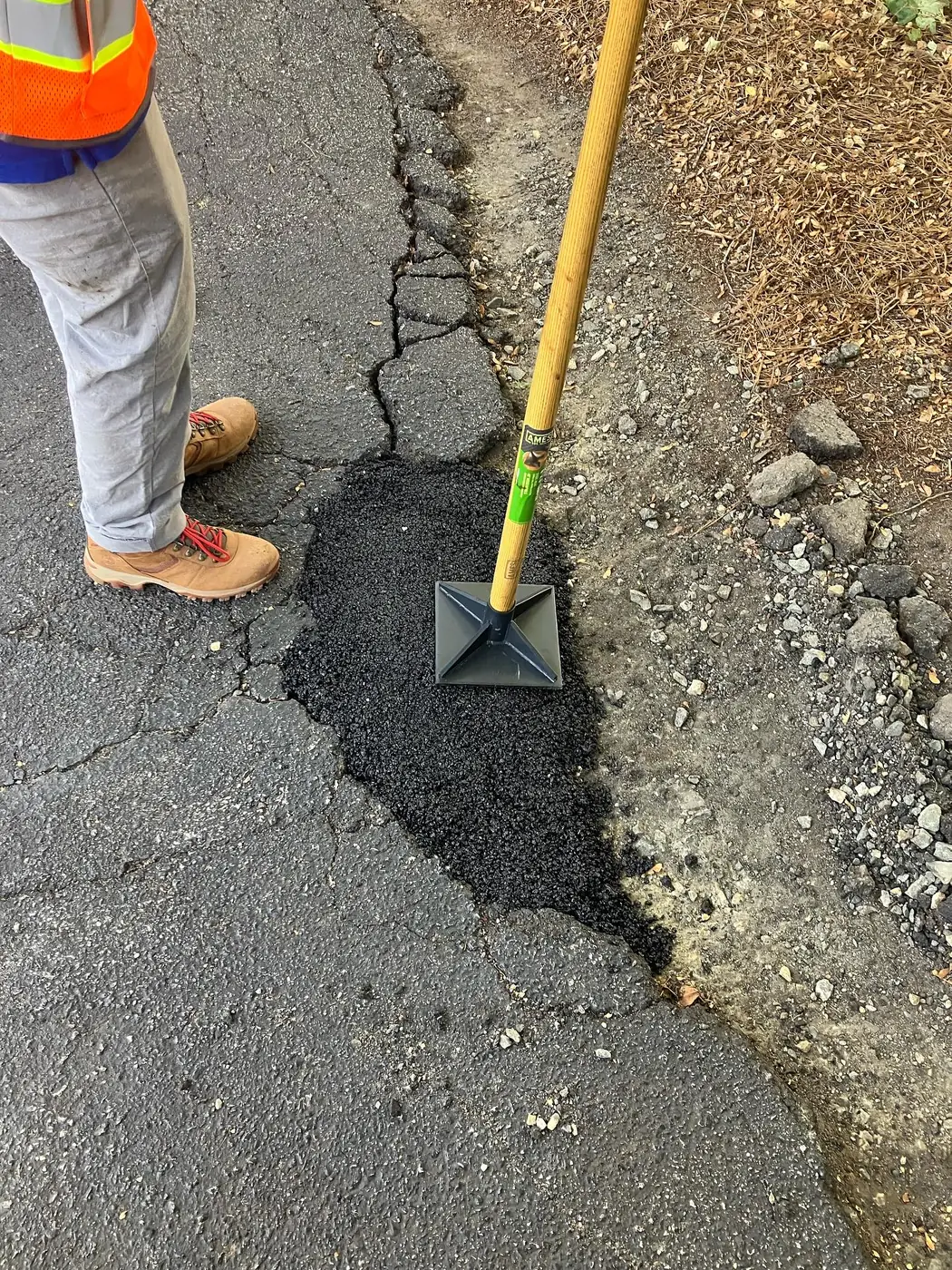
- The surface fails. That flexing eventually breaks the surface layer entirely — and that's a pothole, not a crack anymore. What would have been a linear-foot crack-filling job is now a patch or a full-depth repair.
The Piedmont Triad sees a real number of freeze-thaw cycles each winter — not one hard freeze, but repeated swings above and below 32°F across December through February, sometimes into March. Every one of those swings is another expansion cycle working on any crack that already has water in it. Pavement here ages faster under neglect than pavement in a climate with one long, steady winter freeze.
The different types of cracks, and what each one tells you
Hairline / linear cracks
Alligator cracking
Edge cracks
Joint / reflective cracks
Alligator cracking is the one exception worth flagging specifically: it means the base underneath has already failed, and crack sealant alone won't fix that. If we see alligatoring during an inspection, we'll tell you it needs patching or a more involved repair rather than sell you a crack-fill job that won't hold.
How professional crack filling actually works
The process matters as much as the material. A rushed crack fill — squeegeeing cold sealant across a dirty crack — tends to fail within a season. A proper job looks more like this:
- Clean the crack. Debris, vegetation, and loose material get blown or routed out. Sealant that goes over dirt doesn't bond to the pavement underneath it.
- Rout where needed. Wider or more established cracks get routed — cut into a slightly wider, more uniform channel — so the sealant has a consistent reservoir to sit in rather than trying to bridge an irregular gap.
- Apply hot-pour rubberized sealant. This is the industry-standard material for asphalt crack sealing. It's heated to a specific application temperature, flexes with the pavement as it expands and contracts through the seasons, and bonds far better than cold-pour products.
- Let it cure before opening to traffic. Sealant needs time to set before cars roll over it; rushing this step is a common way DIY jobs end up tracked across the lot instead of staying in the crack.
When crack filling is the right call — and when it isn't
Crack filling is most effective early: while cracks are still linear or minor, before they've widened enough to let significant water through repeatedly. Once a section has progressed to alligator cracking, potholes, or visible base failure, sealant is no longer the right tool — that area needs patching or, in more advanced cases, a mill-and-overlay. Part of what we do during an inspection is sort your lot into "seal this now" versus "this needs patching first," so you're not paying for a maintenance step that won't hold on a section that's already failed.
What a good maintenance rhythm looks like
Inspect at least once a year
Ideally in spring, right after winter has had its chance to do its worst — that's when new cracks are easiest to spot.
Fill before winter if you can
Sealing cracks in fall, before the freeze-thaw season starts, keeps water out during the months it does the most damage.
Pair it with sealcoating
Crack filling should happen before sealcoating, not after — the seal coat needs a sound, filled surface to bond to.
How wide does a crack need to be before it's worth filling?
As a general guide, cracks wider than about a quarter inch are worth prioritizing for filling, since they let meaningfully more water through than hairline cracks. That said, filling hairline cracks early, before they widen, is often the cheapest maintenance dollar you'll spend on the whole lot.
Can I fill cracks myself with a tube of cold-pour sealant from a hardware store?
You can, and for a handful of small cracks on a low-traffic driveway it may hold reasonably well. On a commercial lot with real traffic and Piedmont Triad winters, cold-pour products from a tube generally don't bond or flex as well as professionally applied hot-pour rubberized sealant, and tend to need redoing within a season.
My lot has alligator cracking in a few spots. Is crack filling still worth it?
Crack filling won't fix alligator cracking on its own — that pattern means the base has already weakened. We'd recommend patching those specific areas, and crack-filling the rest of the lot where cracks are still linear and the base is sound.
How soon can the lot be used after crack filling?
Hot-pour sealant typically needs a short cure window before traffic returns — often within the same day, depending on temperature and humidity. We'll let you know the expected reopening time for your specific job and weather conditions.
Catch it while it's still a crack, not a pothole
We'll walk your lot, sort what needs sealing from what needs patching, and give you a straightforward quote — before the next freeze-thaw cycle makes the decision for you.