
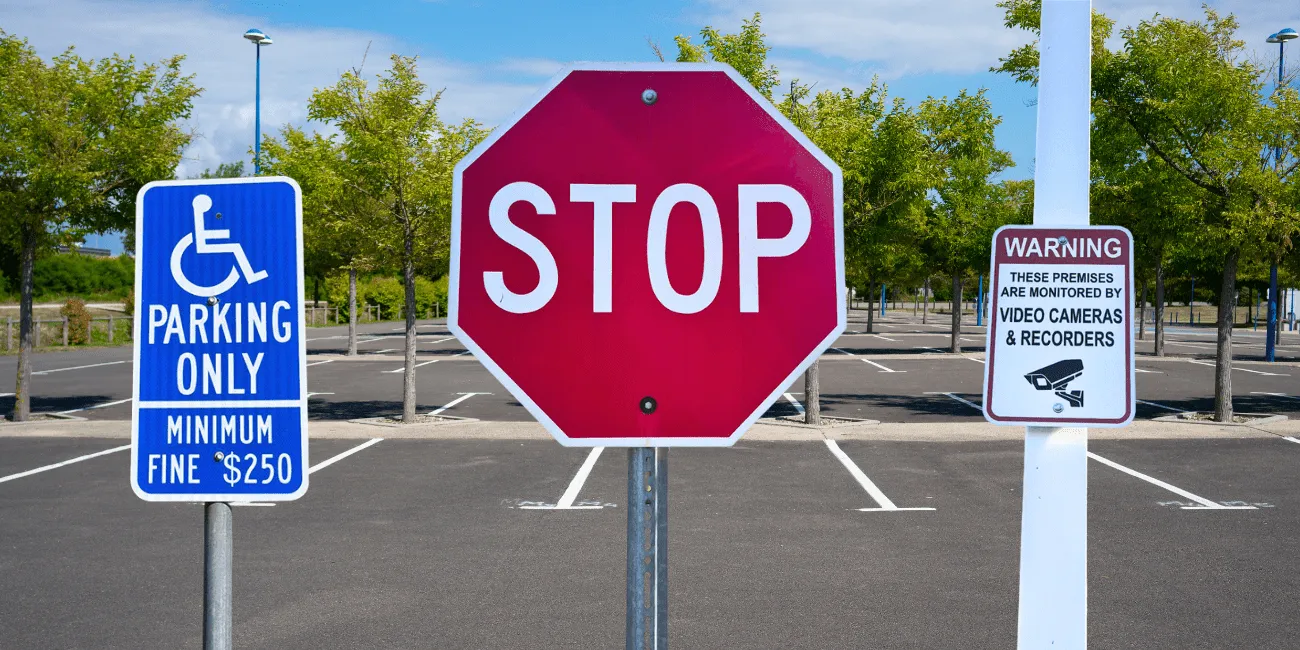
Non-compliant accessible parking exposes a business to accessibility complaints, potential civil penalties, and real safety hazards — not because owners set out to cut corners, but because layouts drift. Across retail centers, medical offices, apartment communities, and churches, the same pattern shows up: a layout that was correct once, and has slowly drifted out of spec across several repaints since. This guide covers ADA requirements, fire lane standards, materials, and maintenance, so you can tell which category your lot falls into.
ADA parking space requirements: the baseline
Standard accessible space
- 96 inches (8 feet) wide minimum
- 60-inch access aisle adjacent to the space, which can be shared between two adjoining accessible spaces
- A continuous accessible route connecting to the building entrance
Van-accessible space
- 96 inches (8 feet) wide, paired with a 96-inch access aisle (wide enough for a lift to deploy)
- Must be located on the shortest accessible route to the entrance
- Required for at least 1 in every 6 accessible spaces (rounded up)
Signage & symbols
- International Symbol of Accessibility on the ground and/or a post-mounted sign
- Sign typically mounted 54–66 inches high, positioned so it can't be blocked by a parked vehicle
- Text reading "Reserved for People with Disabilities" or your state's equivalent language — check local requirements, since several states layer additional wording or fine-amount notices on top of the federal baseline
Fire lane & no-parking zone standards
Fire lanes need to stay clear 24/7 for emergency vehicle access. In practice that means:
- A width specified by the local fire marshal — commonly around 20 feet, but confirm with your jurisdiction
- Yellow paint with "NO PARKING — FIRE LANE" lettering, legible from a moving vehicle
- Curb markings repeated at regular intervals along the lane's full length
Cities can ticket or tow vehicles parked in fire lanes, and property managers are often on the hook for enforcement and towing coordination when markings are unclear. Legible paint is the cheapest prevention available.
Paint options and how long they actually last
| Material | Typical lifespan | Relative cost | Best use |
|---|---|---|---|
| Acrylic latex paint | 12 – 18 months | Lowest | Budget lots, high-turnover sites |
| Oil-based paint | 18 – 24 months | Moderate | Most commercial lots |
| Thermoplastic (hot applied) | 3 – 5 years | Higher | High-traffic, premium lots |
| Preformed thermoplastic tape | 3 – 5 years | Highest | Complex symbols, maximum durability |
For most commercial lots, oil-based paint strikes the best balance of cost and durability. Thermoplastic is worth the premium in the highest-traffic areas — crosswalks, ADA symbols, main drive lanes — where the extra years of life more than justify the difference.
The striping process, start to finish
- Surface prep via pressure washing or wire-brushing — paint applied over dirt or oil peels far sooner than paint on a clean surface.
- Precise layout using chalk or string lines rather than eyeballing it against old, faded marks.
- Two coats — an adhesion coat first, then a visibility coat.
- Curing for roughly 4 to 8 hours before the lot reopens, depending on weather.
Repaint frequency follows the material: 18 to 24 months for paint on high-traffic lots (stretching to 24 to 36 months on low-traffic ones), and 3 to 5 years for thermoplastic. Repainting proactively once markings have faded 30 to 40% tends to be cheaper and safer than waiting until they're unreadable.
10-point compliance checklist
Before finalizing any striping project, verify:
- Total accessible spaces meet the required ratio for your lot's actual current size (not the count from an old site plan)
- Van-accessible spaces are provided at 1 in 6 accessible spaces minimum
- Access aisles are adjacent to marked accessible spaces (sharing is allowed)
- Access aisle width is correct — 60 inches standard, 96 inches van-accessible
- Every accessible space has both a post sign and a ground symbol
- Fire lanes are clearly marked and physically unobstructed
- An accessible route connects parking to the building entrance
- Stripe width is consistent — 4 inches standard, 6 inches in high-visibility areas
- The surface was properly prepped before striping went down
- Sealcoating or pressure washing was completed before striping, not after
Common mistakes and the liability behind them
- Under-providing accessible spaces to preserve more revenue stalls. It's rarely worth the exposure — calculate the required count correctly against your actual total, every time.
- Incorrect access aisle width. Wheelchair users genuinely need the full 60 inches to deploy a mobility device; a too-narrow aisle isn't compliant regardless of how it looks.
- Striping over an unprepared surface. Paint applied over dirt or oil often peels within 6 to 12 months. Proper prep adds real years to the paint's life.
- Faded fire lane markings. Unclear yellow paint leads to vehicles parking where they shouldn't, and towing liability follows.
Worked example: bringing a 60-space lot back into compliance
A medical office lot is a useful case study because accessibility carries more weight there than almost anywhere else. Take a 60-space lot with outdated striping: accessible spaces marked to an older standard, access aisles narrower than current guidance requires, and fire lanes faded to the point drivers no longer notice them.
Under the 2010 ADA Standards, a lot with 51 to 75 total spaces needs 3 accessible spaces minimum. At least 1 in every 6 accessible spaces must be van-accessible, which at this size means 2 standard accessible spaces and 1 van-accessible space. The corrective work involves recalculating the accessible count against the lot's actual current total (not the old layout), resetting access aisles to the correct width, repainting the wheelchair symbol at each accessible space, restoring fire lanes in clear yellow with legible lettering, and choosing a marking material suited to the traffic the lot actually carries. Re-measuring instead of simply painting over the old lines is what stops the layout from drifting further out of spec.
Can I touch up faded stripes instead of a full restripe?
Partial touch-ups are possible for minor fading, but they tend to look patchy — new paint next to old is more noticeable than uniformly worn paint. A full restripe every 18 to 24 months (paint) or 3 to 5 years (thermoplastic) generally looks and holds up better.
How do you handle custom markings like a company logo or reserved spaces?
Custom symbols and text — logos, "Manager Reserved," and similar — are straightforward with thermoplastic stencils or paint, priced per marking. We'll check any custom layout against ADA requirements before it goes down.
Should I stripe before or after sealcoating?
Always sealcoat first, then stripe one to two weeks later once the coating has cured. Striping fresh sealcoat marks the surface, and striping old, oxidized asphalt gives the paint a poor bond. The correct sequence gets you the most durability from both.
What about loading zones and reserved parking?
Loading zones (yellow "No Parking — Loading Zone" markings with time limits) and reserved parking ("Manager," "Delivery Only," etc.) both make a lot easier to manage day to day. They're priced per marking and can be done in paint or thermoplastic depending on how much traffic that area sees.
Get a free striping assessment
We'll measure your lot against current ADA and fire code standards, flag anything that's drifted out of spec, and quote a straightforward fix.