Across the lots we walk in Greensboro and the Triad, the pattern is predictable: small cracks turn into bigger ones, oxidized gray asphalt gets more brittle every summer, and a lot that could have been protected for another five years quietly becomes a resurfacing project. Sealcoating is the maintenance step that interrupts that pattern — and the difference between staying ahead of it and falling behind is usually the difference between a routine line item and a capital expense that needs board approval.
This guide covers what sealcoating actually does, the real trade-offs between the three common sealcoat types, what a proper application involves, and how to think about the timing and cost math over a five-year horizon.
What sealcoating actually does
Think of sealcoat as sunscreen for your asphalt. Left untreated, asphalt oxidizes under UV exposure the same way skin does — it hardens, gets brittle, and starts cracking. Once cracks form, water gets in, and freeze-thaw cycles expand those cracks into potholes. At that point you're no longer maintaining a lot; you're replacing one. A sealcoat applied on a routine two-to-three-year cycle blocks UV and water from ever reaching the asphalt directly, which is why properly maintained lots commonly reach 15 to 20 years of service life compared to roughly 10 to 12 years for a lot that's never resealed.
Three types of sealcoat, and how to choose
| Type | Typical durability | Relative cost | Best for |
|---|---|---|---|
| Coal-tar sealcoat | 3 – 5 years | Moderate | High-traffic commercial lots where durability matters most |
| Acrylic sealcoat | 2 – 3 years | Lowest | Budget-conscious properties, moderate traffic |
| Bio-based sealcoat | 2 – 3 years | Highest | Properties with sustainability or ESG priorities |
Coal-tar: the durability choice
A blend of coal-tar, mineral fillers, and a water-based binder that cures into a deep black, hard protective layer. It's the longest-lasting of the three options and performs best under heavy, repeated traffic — which is why it's the default recommendation for shopping centers, parking garages, and logistics facilities. The trade-off is higher VOC content than the alternatives, a longer cure time (72-plus hours), and some jurisdictions place restrictions on its use, so it's worth checking local rules before committing.
Acrylic: the budget-conscious option
A water-based acrylic polymer that applies quickly, cures faster (24 to 48 hours), and carries lower VOC emissions. It costs less upfront but has the shortest lifespan of the three, and its color fades faster under UV, so it needs reapplication more often. It's a reasonable fit for smaller office parks, apartment complexes, or municipal lots working within a tighter maintenance budget.
Bio-based: the premium eco-option
Made from organic materials such as soybean or lignin derivatives, bio-based sealcoat carries essentially zero VOCs and appeals to organizations with sustainability commitments. Durability lands in the same range as acrylic (2 to 3 years), it's the most expensive of the three, and product availability can be more limited depending on your supplier — so it's worth confirming lead times if you're set on this option.
What a proper sealcoating job actually involves
- Inspection and prep planning. We walk the full lot, photograph existing conditions, and flag cracks or damage that need to be addressed before sealing — sealing over unresolved damage just traps the problem underneath a new black surface.
- Crack filling. Cracks wider than about a quarter inch get filled with rubberized asphalt sealant first, so water can't get through the seal layer at those points.
- Pressure washing and surface prep. The entire surface gets cleaned to remove oil, dirt, and oxidized residue — this is the single most important step for adhesion, and the lot needs roughly 24 to 48 hours to dry fully before sealer goes down.
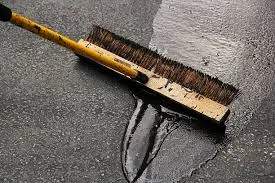
- Sealcoat application. Two coats, applied by squeegee or spray depending on the job — a thin adhesion coat first, then a protective second coat, spaced four to six hours apart to let the first coat set properly.
- Curing and inspection. The lot stays roped off for 24 to 72 hours depending on temperature and humidity before we release it back to full traffic, with a final walk-through to confirm even coverage.
The five-year math: sealcoating vs. letting it ride
Without sealcoating
With sealcoating every ~3 years
The maintenance route tends to win on both total cost and budget predictability: a series of planned, moderate sealing jobs versus one unplanned resurfacing bill that arrives on its own schedule, not yours.
When to reseal
- High-traffic lots (retail, shopping centers): reseal every 2 to 3 years.
- Medium-traffic lots (offices, apartments): reseal every 3 to 4 years.
- Low-traffic lots (light industrial, residential): reseal every 4 to 5 years.
Reseal sooner if you notice fading to a dull gray instead of deep black, new hairline cracks appearing, or if the previous seal job was thin or substandard and only lasted a year or two.
Mistakes that shorten a sealcoat's life
- Skipping surface prep. Saving a day by skipping the pressure wash is the single fastest way to get a seal that fails within 12 to 18 months instead of 3 to 5 years.
- Sealing over unrepaired potholes or deep cracks. The damage keeps spreading underneath the new coating, out of sight, until it reappears.
- Waiting too long between reseals. Once extensive cracking has developed, the pre-seal repair work costs meaningfully more than it would have on a normal 3-to-4-year cycle.
- Choosing strictly on lowest price. Thin coating and rushed curing are the usual reasons a "cheap" seal only lasts a year or two — the up-front saving disappears the moment it needs to be redone.
Worked example: sealing instead of resurfacing
Consider a four-lot office complex, roughly 120,000 square feet total, last sealed about six years ago — heavy UV fading, visible cracking on two of the four lots, and some edge deterioration. The facility manager has resurfacing quotes in hand and a budget that won't cover them. The question that matters most here isn't the price of any one option; it's whether the pavement is structurally sound or has actually failed. Surface cracking isn't the same as base failure. If the base is intact and the cracking hasn't progressed to potholes or alligatoring, the lot is usually still a strong candidate for maintenance rather than replacement.
In that scenario, the plan typically looks like: crack filling concentrated on the two worst lots, pressure washing all four surfaces so the sealer has something clean to bond to, two coats of sealcoat phased lot by lot to keep the complex operating, and specific attention to the deteriorating edges, since that's where water tends to get in first. Sealing a sound lot on a regular cycle costs a fraction of resurfacing it and pushes that decision out by years — but sealing a lot that's genuinely failed just puts a black coat over a structural problem. That distinction is the entire value of a proper site visit, and if your lot needs paving rather than sealing, we'll tell you that directly.
Can I apply sealcoat to brand-new asphalt?
Wait about 12 months after new asphalt installation before sealing. New asphalt is still curing and off-gassing, and sealcoat applied too soon won't adhere properly.
How soon after sealcoating can I stripe the lot?
Give the seal 48 to 72 hours to fully cure before striping. Striping too soon risks the paint not adhering well to a coating that hasn't finished setting.
Is sealcoating a permanent fix?
No — it's a protective maintenance step, not a cure-all. Think of it as sunscreen rather than a one-time repair: it needs reapplication every 2 to 4 years to keep protecting the surface underneath.
Can I drive on the lot right after sealcoating?
No. Curing takes roughly 24 to 72 hours depending on temperature and humidity. Driving too soon leaves tire tracks and mars the finish — we rope off the area and can help arrange alternate access during that window.
Find out if your lot is a maintenance job or a replacement job
We'll walk your property, tell you honestly which category it falls into, and quote the work that actually makes sense for your budget and timeline.